
It's Racism.
If we can't confront reality, we can't do anything.

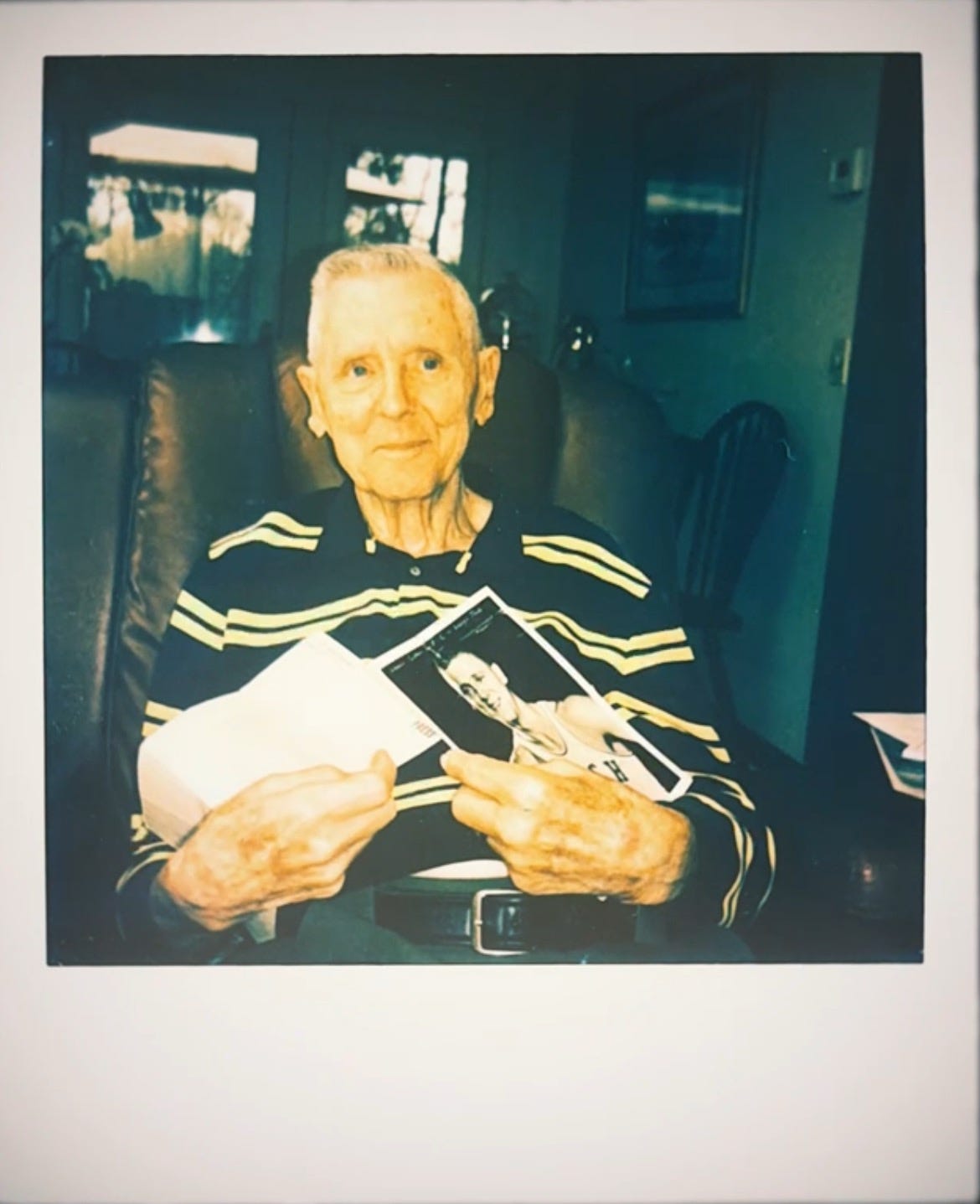
My grandfather played college basketball.
He almost played professionally, but he broke his leg senior year and it never healed right. That he almost went pro is not true just in his head, like it is for most middle-aged men three beers deep. In a scrapbook in my grandparents’ home in north Georgia, there is a letter from the Atlanta Hawks—at the time, based in Saint Louis—asking him to join the team.
Some photographs of my grandfather capture him as an athlete, even ones taken decades after he hung up his jersey. In these photographs, I can really see him. I can see him in a way that reminds me that not so long ago, he, too, was in his thirties, was even younger. These photographs fill me with tenderness. I almost always send them to my friends. There is something special about seeing an elder like this, especially a father or a grandfather, those taught by patriarchy to hide their sentimentality and vulnerability and inner selves from the world. It is a miracle, to get to see them in this way, to get to see yourself in them. Of course you want to share it.
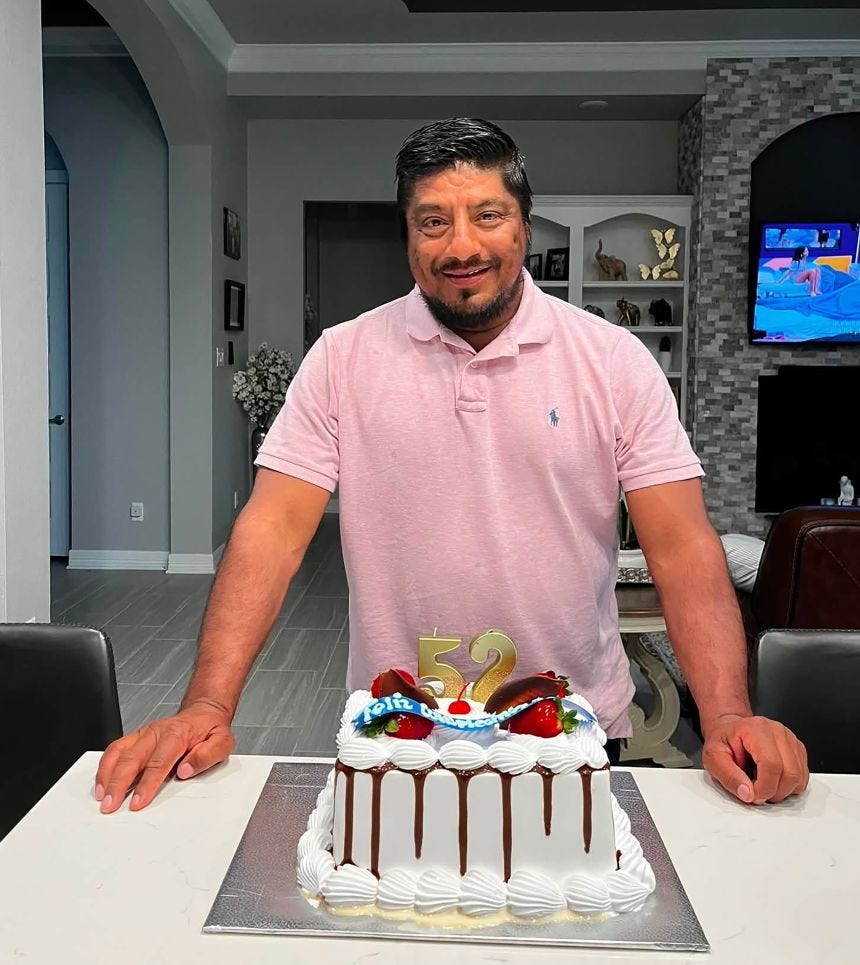
Each time I see a new photograph of Lorenzo Salgado Araujo, I feel briefly as though one of my friends has sent me a picture of their father. Their father likes his big hat, the smile playing across his face one that lets you picture him as a small boy. Their father feels loved, surprised by a beautiful birthday cake, and is looking at them with so much love in return that they felt compelled to show me. Their father is standing among them, bursting with pride looking at his family, a pride so deep I can feel it radiating off him. The photographs show him so plainly. Of course they would send them.
Then I remember I do not know Lorenzo, that I know who he is only because American tax dollars paid a group of masked men to murder him because he is Mexican. I remember I do not know his children, people who learned of their father’s death via a video on Facebook that captured him begging for help as he bled out in the street. I remember I am seeing these pictures because his children had to hold them in front of a horde of cameras the day after their father’s adopted country murdered him, again begging for help, begging people to see him.
They are only begging white America. Everyone else can see Lorenzo quite clearly.
Shortly after Renee Nicole Good was murdered by the same-but-different masked men, I traveled to Minneapolis. Her face was everywhere. One ubiquitous poster showed her in black and white, over the words RENEE NICOLE GOOD: AMERICAN MOM, MURDERED BY ICE.
Months prior, ICE murdered Silverio Villegas Gonzales, a father living in Chicago. Months later, ICE murdered Lorenzo.
As I speak about the comparative lack of outrage and coverage for Lorenzo, a few patterns of deflection emerge, common enough that they are worth addressing. The first is the allegation it is difficult to get an ICE murder to “break through” when there is a lack of video.
There is video of Lorenzo’s murder. His family has requested it not be shared, likely at least in part because Lorenzo’s son Ronaldo learned of his father’s murder when he clicked on a social media post documenting his father bleeding out on the ground. Ronaldo could hear his father asking for help as ICE stood over his handcuffed body.
When I point this out, the white people making the comment double down, saying the family, unfortunately, should know that without video, the story will not resonate with as many people.
On February 22, 2024, Laken Riley, a twenty-two year old white woman out on a jog, was murdered by an undocumented immigrant. Later that year, every Congressional Republican, and 60 Congressional Democrats, voted for the Laken Riley Act, a bill requiring ICE to detain immigrants accused of low-level crimes like shoplifting, disappearing countless people into concentration camps in her honor.
There is no video of Laken Riley’s murder.
The second widespread deflection is a declaration Lorenzo’s murder is being covered, because there are videos about it on social media, or some coverage on the news.
Less than a week after ICE murdered Renee Nicole Good, a poll showed more than 80% of American voters knew enough about her to have an opinion about her murder. Two and a half days after Lorenzo’s murder, as I draft this paragraph, there is no article referencing his murder on the landing page of the New York Times. Searching for his name returns an article titled ICE Officer Kills a Mexican Man in Houston. Its subtitle ‘reports’ [t]he agency said the man was an “illegal alien” who had tried to run over the agent, though no evidence was immediately offered. One might reasonably wonder why the paper of record is sharing claims with no evidence supporting them.
The reason more Americans know about Renee than they know about Lorenzo is racism. Racism is not one reason of many; it is the reason. There are other things white people will tell themselves. They are wrong.
As I scrolled the Times’ landing page looking for coverage of Lorenzo’s murder I did not find, I stumbled across an article about the Lincoln Memorial’s reflecting pool, a topic that has dominated liberal and centrist media for weeks. There is an algae bloom in the pool. There are concerns the water may be toxic to ducks. The paint is turning green and is supposed to be blue.
Media covers what American decision-makers believe will interest the American public. Pundits turn conversations to topics they believe will most outrage viewers. Algorithm-chasing social media commenters post about things they believe will cut through the never-ending noise of the internet, things that feel shocking.
What does it say about us, that the people who stake their careers on identifying topics to hold our attention have decided Lorenzo’s murder is not shocking, or outrageous, or even interesting enough to prioritize above algae?
It says something honest.
Comparative silence around ICE murders of Lorenzo and Silverio reflects a truth so vile that Americans don’t wish to admit it to themselves: we only really care when white people are murdered. Some voice fear this lack of care for everyone else will be normalized. We normalized it years ago. We normalized it at the founding.
On December 31, 2025, an off-duty ICE agent murdered Keith Porter, a Black father of two, outside Keith’s home. Keith is rarely included in lists of ICE murders during Trump’s second term. I agree with this decision on some levels; it is fair to differentiate Keith Porter’s murder because the kind of violence it illustrates is different. But because he is not discussed together with those ICE murders during its official duties, he is not discussed at all.
Keith Porter’s story is not about impunity for ICE agents as they murder people while carrying out government-sponsored abductions. Keith’s death is not even about the way our society has normalized state agents murdering Black people. It is about how American culture has accepted the murder of Black people by white and white-passing private citizens, so much that these murders barely register.
On July 4, an eighteen-year-old named Nolan Wells went out boating with three friends. Nolan is Black. The other three boys were white. They took the boat to an island about ten miles out to sea, and when the boat returned, Nolan was not on board. Days later, Nolan’s body was recovered.
The sheriff told the press Nolan’s friends went back without him. From what we understand, he said, speaking of an eighteen-year-old ten miles off the coast, he chose to stay there.
Several months ago, a friend texted me a screenshot of a brief in Louisiana v. Callais, the case that obliterated protections against racist gerrymandering in the South, where the attorneys trying to overturn the Voting Rights Act quoted Martin Luther King, Jr. to support their argument.
At this point, she said, I think my only question is whether these people are laughing out loud as they write these things down, because I know they know exactly what they’re doing.
On June 15, the Los Angeles Police Department shot and killed a goldendoodle. Outrage was so swift and widespread that the LAPD opened an internal investigation within days. Mayor Karen Bass issued a statement, declaring [e]very life lost to violence is a tragedy.
On June 14, Mississippi police fired on a car and claimed they did so because the driver was accused of shoplifting. In doing so, they murdered a one-year-old child named Kohen Wiley. His mother was allegedly shoplifting diapers. She had a receipt showing purchase in her car. Kohen and his mother are Black.
A few weeks later, I talked about my discomfort with spending limited airtime in an attention economy focused on the goldendoodle.
I usually agree with you, but this is the wrong take, many commenters declared. Both break my heart. Can’t I care about both the same?
Our society has grappled with its foundational racism so little that white people can profess they care about the murder of a Black child in the same sentence where they argue the value of that child’s life is indistinguishable from the value of the life of a dog.
The past year and a half is full of declarations the United States has entered some new, unrecognizable era. These declarations are false, which is why they are so popular. The murderous nature of the United States is morphing and expanding. We are right to fear normalization of a racist civil agency murdering people in the streets, disappearing people to camps, forcing them to work for free there. Those things are becoming normal because they already were normal in the criminal legal system, which ignores crimes committed by white people against Black people and disappears poor Americans, disproportionately Black, into work camps rife with abuse of all kinds. Those things are normal because our country normalized segregation, which was normal because our country normalized slavery. We have never reckoned with any of those things. We have simply declared ourselves done with them, and pretended that eliminates the context that allowed them in the first place.
My grandfather is ninety-one years old.
When he passes away, I will be devastated. I have told my family I want the letter from the Saint Louis Hawks. If they let me keep the letter, I plan to frame it. Nearby, I will hang some of the photographs of my grandfather that capture him most honestly, the ones that let me see him not just at ninety-one, but as a whole person, and let me see myself in him.
My grandfather played college basketball on a segregated basketball team.
At the time, it seemed normal to him. It was just the way things were.
At the time, Black activists were risking their lives to end segregation. Some of them did not survive. Some white people joined them, because it was blatantly apparent that segregation was unjust. Most white people did not.
Today, we are told this was simply a different time, as though seeing a person as a person is easier now than it was less than a lifetime ago. White Americans tell ourselves we are better than our forefathers while justifying their active or passive participation in things we know were evil because we love our families and see ourselves in them.
We are right to see ourselves there. We should look a bit harder.
When I was a child, our front yard was overrun with dandelions. My mother hated them, or at least wanted me out of the house, and paid me a quarter for each one I dug up. The first time this was offered, I tore through the grass, plucking dandelion after dandelion, and brought her a pile of stems. She rejected all of them, obviously. Anyone who has ever weeded knows you have to dig up the roots.
Because I’d picked all the yellow tops, trying to get the chore done as fast as possible, I couldn’t even tell where the roots were anymore. She told me to try again a different day.
Ultimately, that’s all you can do. The weeds will show up again and again, until you dig them all up. Every time they reemerge, you’re faced with a choice between the quick, easy, temporary non-solution, and doing the work necessary to actually get rid of them. Eventually, unless you do the work, the roots choke everything else out.
Lorenzo looks like a man who loved flowers, who would stop and point them out to his children. He looks like a man who would see a bouquet and bring it home to his wife. He looks like a man who would feel a breeze and see it rustle the leaves of a tree and smile to himself.
Maybe I’m projecting, seeing too much of my own family in his face. There are worse things.
This was beautifully written
Thank you again for all you're doing. I could not agree more. The racism is as real as the sun, moon and stars. And I think your dandelion analogy is exactly right.
We have got to learn to see each other with kindness, compassion and a heart for justice and accountability. There is no other way but death dealing.